
If you are trying to identify the rear axle in a Ford truck, van, SUV, or older Ford vehicle, one of the best places to start is the AXLE code on the vehicle’s Safety Compliance Certification Label.
That code can help identify information such as the factory rear-axle ratio and, on some vehicles, whether the axle uses a conventional or limited-slip differential. There is one important catch: Ford axle codes are not one universal code system that means exactly the same thing on every Ford ever produced.
Quick answer: Find the AXLE field on the certification label near the driver’s door, record the code exactly, then decode it using the chart for your Ford model and model year. If the vehicle is old or modified, verify the axle that is physically installed before ordering parts.
Ford’s own manuals organize rear-axle codes by vehicle and application. That means the safest decoding formula is:
Vehicle model + model year + AXLE code = useful axle identification
This guide brings together Ford factory owner documentation, Ford towing material, and drivetrain information from Dana/Spicer to explain what the code means, where to find it, and how to avoid one of the biggest problems with generic internet axle-code charts: treating a code as universal when Ford reused or changed code systems across applications.
Ford Axle Code Guide: Jump to a Section
- Where to find the Ford AXLE code
- What the code can—and cannot—tell you
- Why model year matters
- Verified Ford axle-code charts
- Conventional, limited-slip, and locking differentials
- What 3.55, 3.73, and 4.10 ratios mean
- How to decode your Ford axle code step by step
- Ford H9 axle-code example
- What to verify before buying parts
- Primary sources used for this guide
Watch: How a Differential Ring and Pinion Are Set Up
If the numbers in an axle-ratio chart feel abstract, this university automotive-training video gives useful mechanical context. Weber State University’s Automotive Technology Department walks through the ring gear, pinion gear, backlash, bearing preload, and gear-tooth contact pattern.
Dana/Spicer defines axle ratio using the relationship between the differential’s ring gear and pinion gear. Divide the ring-gear tooth count by the pinion-gear tooth count. For example, 41 ÷ 11 ≈ 3.73, producing a 3.73:1 ratio. Dana/Spicer’s gear-ratio calculator explains the relationship.
Where Is the Ford Axle Code?
On many Ford vehicles, the code is found on the Safety Compliance Certification Label near the driver’s seating position. Ford’s current owner documentation says the label may be affixed to the door hinge pillar, door latch post, or edge of the door near the latch. See Ford’s vehicle-certification-label documentation.
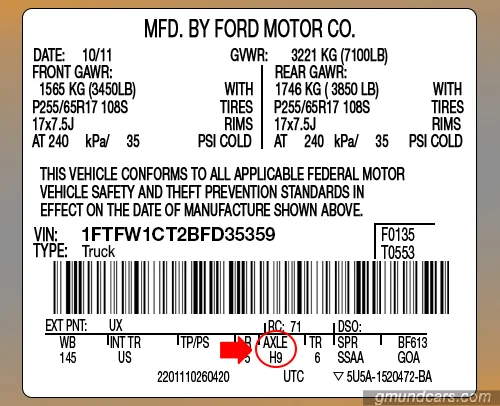
Look for the field marked AXLE, typically in the lower portion of the label. Record the code exactly as printed. Depending on the Ford and year, it may be numeric or alphanumeric—for example 17, H9, F7, or 7L.
Do not confuse the certification label with a physical axle tag
The vehicle certification label is attached to the body near the driver’s door. A physical axle or differential identification tag is a separate identifier associated with the axle assembly itself. Both can be useful, but they are not the same thing.
This guide primarily decodes the AXLE field on Ford’s vehicle certification label. If an older vehicle may have had its axle replaced, the door label tells you the original factory configuration—not necessarily what is underneath the vehicle today.
What Does a Ford Axle Code Tell You?
Depending on the vehicle and model year, Ford’s factory documentation may associate an axle code with:
- Rear-axle gear ratio
- Conventional or limited-slip differential type
- Axle manufacturer, such as Ford or Dana in some older charts
- Listed axle capacity in some factory manuals
The exact data varies by application. For example, Ford’s 1996 F-Series manual groups codes into conventional and limited-slip sections and gives manufacturer, capacity, and ratio. Ford’s 1997 Ranger manual similarly distinguishes conventional Ford axles from Ford Traction-Lok configurations.
What the AXLE code does not reliably tell you by itself
An axle code should not be treated as a substitute for the VIN or as a universal description of the entire vehicle. Ford’s older manuals, for example, use a separate VIN position to identify engine type. The axle-code section and engine-identification section are separate systems.
Important correction to many online decoder charts: Do not assume the AXLE code alone identifies the engine, exact axle housing, or every component inside the differential. Use the exact Ford documentation for the vehicle and physically verify the axle when replacement history is unknown.
If you are diagnosing an actual axle failure rather than identifying a ratio, see our guide to broken-axle signs and causes.
Why the Ford Model and Model Year Matter
This is the most important concept in the entire guide: do not decode a Ford axle code in isolation.
Ford’s own factory documents use different code sets for different vehicles and eras. A 1996 F-Series chart contains codes such as 12, 17, 19, B9, H7, H8, and H9. A 1997 Ranger chart instead uses codes such as 82, 84, 86, F6, F7, and R5. A newer Transit towing guide uses codes such as 31, 3L, 73, 7L, 41, and 4L.
That is why a generic internet statement such as “code X always means Y on every Ford” should be treated cautiously.
Best practice: Search and verify year + model + AXLE code, not the axle code alone.
Verified Ford Axle Code Charts
The tables below are intentionally separated by application rather than merged into one ambiguous master chart. The values are taken from Ford factory documentation.
1996 Ford F-Series — Conventional axle codes
Ford’s 1996 F-Series owner’s guide lists the following conventional rear-axle configurations for F-150, F-250, F-350, F-Super Duty, and related commercial chassis applications. Ford factory source.
| Code | Description | Capacity | Ratio |
|---|---|---|---|
| 12 | Ford | 3,800 lb | 2.73 |
| 17 | Ford | 3,800 lb | 3.31 |
| 18 | Ford | 3,800 lb | 3.08 |
| 19 | Ford | 3,800 lb | 3.55 |
| 25 | Ford | 5,300 lb | 4.10 |
| 29 | Ford | 5,300 lb | 3.55 |
| 35 | Ford | 6,250 lb | 4.10 |
| 39 | Ford | 6,250 lb | 3.55 |
| 45 | Ford | 7,400 lb | 4.10 |
| 49 | Ford | 7,400 lb | 3.55 |
| 65 | Ford | 8,250 lb | 4.10 |
| 68 | Ford | 8,250 lb | 4.88 |
| 69 | Ford | 8,250 lb | 3.55 |
| 72 | Dana | 11,000 lb | 4.63 |
| 73 | Dana | 11,000 lb | 5.13 |
1996 Ford F-Series — Limited-slip axle codes
Ford separately lists the following limited-slip configurations in the same 1996 F-Series documentation. Ford factory source.
| Code | Description | Capacity | Ratio |
|---|---|---|---|
| B5 | Ford limited-slip | 5,300 lb | 4.10 |
| B9 | Ford limited-slip | 5,300 lb | 3.55 |
| C5 | Ford limited-slip | 6,250 lb | 4.10 |
| C9 | Ford limited-slip | 6,250 lb | 3.55 |
| D5 | Ford limited-slip | 7,400 lb | 4.10 |
| F5 | Ford limited-slip | 8,250 lb | 4.10 |
| H4 | Ford limited-slip | 3,800 lb | 3.54 |
| H5 | Ford limited-slip | 3,800 lb | 4.10 |
| H7 | Ford limited-slip | 3,800 lb | 3.31 |
| H8 | Ford limited-slip | 3,800 lb | 3.08 |
| H9 | Ford limited-slip | 3,800 lb | 3.55 |
1996 Ford Econoline E-Series — Limited-slip examples
Ford’s 1996 Econoline guide illustrates why application matters. Its E-150/E-250/E-350 limited-slip chart includes both Dana and Ford configurations. Ford factory source.
| Code | Manufacturer | Capacity | Ratio |
|---|---|---|---|
| B4 | Dana | 5,400 lb | 3.73 |
| C2 | Dana | 6,340 lb | 4.10 |
| C3 | Dana | 6,340 lb | 3.54 |
| C4 | Dana | 6,340 lb | 3.73 |
| C5 | Dana | 6,340 lb | 4.09 |
| C9 | Dana | 6,340 lb | 3.55 |
| E2 | Dana | 7,800 lb | 4.10 |
| E6 | Dana | 7,800 lb | 4.10 |
| F2 | Dana | 8,000 lb | 4.10 |
| H7 | Ford | 3,800 lb | 3.31 |
| H8 | Ford | 3,800 lb | 3.08 |
| H9 | Ford | 3,800 lb | 3.55 |
1997 Ford Ranger — Conventional and Traction-Lok codes
Ford’s 1997 Ranger documentation uses a different set of codes. The factory chart distinguishes conventional configurations from Ford Traction-Lok. Ford factory source.
| Code | Differential | Capacity | Ratio |
|---|---|---|---|
| 82 | Ford conventional | 2,750 lb | 3.08 |
| 84 | Ford conventional | 2,750 lb | 3.45 |
| 86 | Ford conventional | 2,750 lb | 3.73 |
| 87 | Ford conventional | 2,750 lb | 4.10 |
| 91 | Ford conventional | 2,750 lb | 3.27 |
| 92 | Ford conventional | 2,750 lb | 3.08 |
| 96 | Ford conventional | 2,750 lb | 3.73 |
| F6 | Ford Traction-Lok | 2,750 lb | 3.73 |
| F7 | Ford Traction-Lok | 2,750 lb | 4.10 |
| R5 | Ford Traction-Lok | 2,750 lb | 3.55 |
2019 Ford Transit — Rear axle ratio codes
Ford’s 2019 Transit towing guide uses a compact code system that again demonstrates why codes must be interpreted in context. Ford factory source.
| Rear axle ratio | Non-limited slip | Limited slip |
|---|---|---|
| 3.31 | 31 | 3L |
| 3.73 | 73 | 7L |
| 4.10 | 41 | 4L |
Ford’s 2025 towing guide still instructs owners to use the Safety Compliance Certification Label and its AXLE code to identify rear-axle ratio on applicable vehicles, reinforcing that the basic process remains relevant even though the codes vary by vehicle. See Ford’s 2025 RV & Trailer Towing Guide.
Conventional, Limited-Slip, Traction-Lok, and Locking Differentials
A ratio such as 3.55 or 3.73 describes gearing. It does not, by itself, tell you how the differential manages differences in left- and right-wheel speed.
Conventional or open differential
A conventional differential allows the two drive wheels to rotate at different speeds, which is necessary when turning because the outside wheel travels farther than the inside wheel. Older Ford axle charts frequently label this configuration simply as Conventional.
Ford limited-slip / Traction-Lok
Ford uses Traction-Lok terminology for certain limited-slip configurations. Ford’s current owner documentation explains that a limited-slip axle can provide added traction on slippery surfaces, especially when one wheel is on a poor-traction surface, while behaving like a standard rear axle under ordinary conditions. Ford limited-slip documentation.
Locking differential
A locking differential is a different concept from a conventional differential or a clutch-type limited-slip unit. Do not use open, limited-slip, Traction-Lok, and locker as interchangeable terms when identifying parts.
What Does a 3.55, 3.73, or 4.10 Axle Ratio Mean?
The axle ratio is determined by the relationship between the ring and pinion gears in the differential. Dana/Spicer describes the calculation as:
Ring gear teeth ÷ pinion gear teeth = axle ratio

Example:
41 ÷ 11 = 3.73
In broad mechanical terms, a numerically higher final-drive ratio increases torque multiplication at the axle for a given transmission ratio, while a numerically lower final-drive ratio means fewer driveshaft rotations for each wheel revolution. But axle ratio is only one part of the vehicle’s overall gearing and capability.
Do not determine a Ford’s towing capacity from the axle ratio alone. Ford towing guides combine factors such as engine, transmission, drivetrain, body/wheelbase configuration, axle ratio, GVWR/GCWR, and equipment packages. Use the towing guide for your exact vehicle. Ford’s towing-guide hub.
For a deeper comparison of common numerical ratios, see Gmund Cars’ guide to 3.42 vs. 3.73 rear axle ratios.
How to Decode Your Ford Axle Code Step by Step
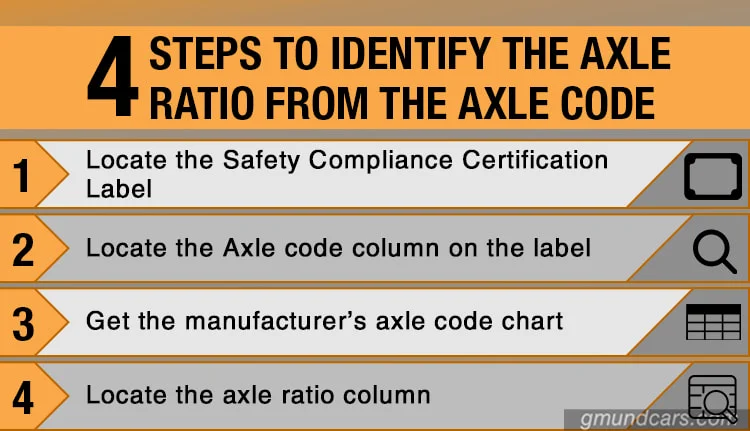
1. Identify the exact vehicle
Record the model year, model, drivetrain, and VIN before decoding the axle. This keeps you from matching the right code to the wrong Ford chart.
2. Find the Safety Compliance Certification Label
Open the driver’s door and inspect the door hinge pillar, door latch post, and door edge near the latch. Exact placement and label layout vary by model and year.
3. Find the AXLE field
Record the code exactly. Do not assume that a number, letter, or individual character has a universal meaning across all Ford vehicles.
4. Use the chart for that model and year
A search such as “1996 Ford F-150 axle code H9” is much safer than searching only “Ford H9.” When Ford factory documentation is available, use it as the primary reference.
5. Verify the installed axle if the vehicle is old or modified
The door label describes the vehicle’s factory build. It cannot tell you whether a previous owner replaced the axle during the last 10, 20, 30, or 40 years. This matters particularly with restorations, off-road builds, junkyard repairs, and drivetrain swaps.
Before ordering expensive drivetrain parts: If replacement history is uncertain, verify the physical axle, differential tag/assembly identification, and installed gearset in addition to the original door-label code.
What If the Axle Tag Is Missing?
The certification-label code can still identify the vehicle’s original factory configuration. If you need to confirm the ratio of the gearset physically installed in the differential, ring- and pinion-tooth counts provide a mechanical check:
Ring gear tooth count ÷ pinion gear tooth count = installed gear ratio
Dana/Spicer provides a gear-ratio calculator for this relationship. Physical inspection or differential disassembly should only be performed when appropriate and safely.
Does Every Ford Axle Code Start With a Letter?
No. Ford’s own charts contain numeric and alphanumeric codes. The 1996 F-Series conventional chart includes codes such as 12, 17, 18, 19, 25, and 29, while its limited-slip chart includes codes such as B9 and H9. The 1997 Ranger uses numeric conventional codes and alphanumeric Traction-Lok codes.
You may notice patterns inside a particular Ford chart, but the safer rule is to use the table for the exact application rather than reverse-engineering individual characters into a universal formula.
Does the AXLE Code Identify the Exact Axle Housing?
Not always. Some Ford factory code tables identify the axle simply as Ford or Dana alongside capacity and ratio. That is not enough evidence to claim a specific ring-gear diameter, spline count, housing engineering number, or brake configuration.
If you are buying an entire axle assembly or internal components, additional identification may include:
- VIN and exact vehicle configuration
- Physical axle tag or assembly number
- Housing characteristics
- Ring-gear diameter
- Axle-shaft spline count
- Brake configuration
- Ford or Dana parts documentation
If you are trying to understand axle construction more generally, our guide to front-axle types, functions, and replacement provides additional background.
Axle-Code Capacity vs. GAWR: Do Not Treat Them as the Same Number
Some older Ford axle-code tables include an axle capacity. The vehicle’s Gross Axle Weight Rating (GAWR), however, is a vehicle rating shown on the certification label. Do not automatically substitute a capacity number from an old axle-code table for the actual GAWR of the vehicle.
Use the certification label and the applicable Ford owner/towing documentation when determining vehicle weight limits.
Ford H9 Axle Code Example
Suppose you have a 1996 Ford F-Series truck and the AXLE field reads H9.
- Confirm the vehicle is covered by the 1996 F-Series chart.
- Locate H9 in Ford’s limited-slip section.
- Ford lists the description as Ford.
- Ford lists a 3,800-lb capacity in that chart.
- Ford lists the ratio as 3.55.
Verified interpretation for this application:
1996 F-Series H9 = Ford limited-slip rear axle, 3.55:1 ratio, 3,800-lb listed capacity.
Notice what this guide does not claim. Ford’s cited table labels the axle description as “Ford”; it does not, in that table, explicitly establish a particular ring-gear diameter. We stop at what the primary source actually supports.
Before Buying Rear-Axle or Differential Parts
- Confirm the model and model year.
- Read the AXLE code from the certification label.
- Decode it using documentation for that vehicle.
- Determine whether the differential is conventional, limited-slip, or locking.
- Confirm the physical axle if it may have been replaced.
- Verify the installed ratio before mixing front and rear drivetrain components on a four-wheel-drive vehicle.
- Use the correct Ford service information for fluid type and capacity.
- Use the exact vehicle towing guide—not axle ratio alone—to determine towing limits.
If the problem is structural rather than identification-related, review the signs and causes of a broken axle before assuming the gear ratio is the source of the issue.
How We Researched This Ford Axle Code Guide
Rather than preserve an unsourced universal code list, this guide prioritizes Ford factory documentation and keeps the tables separated by application. That makes it possible to show exactly what Ford documented without implying that the same code has one meaning across every vehicle and year.
- Ford Motor Company — 1996 F-Series Owner’s Guide: rear-axle codes, conventional/limited-slip groupings, capacities, ratios, and VIN engine identification.
- Ford Motor Company — 1996 Econoline Owner’s Guide: E-Series rear-axle codes and application-specific examples.
- Ford Motor Company — 1997 Ranger Owner’s Guide: Ranger conventional and Traction-Lok codes.
- Ford Motor Company — 2019 Transit Towing Guide: Transit axle-ratio codes and limited-slip/non-limited-slip distinctions.
- Ford Motor Company — 2025 RV & Trailer Towing Guide: current example of Ford directing owners to the certification-label AXLE code.
- Dana/Spicer — Gear Ratio Calculator: ring-gear and pinion-gear ratio relationship.
- Weber State University Automotive Technology — Differential Ring and Pinion Gear Setup: educational mechanical context for differential gearing.
Research principle: When a factory source documents only the ratio, capacity, manufacturer, or differential type, this guide does not add an exact axle-housing claim unless a separate reliable source supports it.
Final Takeaway
Your Ford’s AXLE code is a starting point, not a universal part number.
Find the code on the certification label, combine it with the exact model and model year, and decode it using the corresponding Ford documentation. If the vehicle is old enough that the axle could have been replaced, verify the axle that is physically installed before buying parts.
That extra verification can prevent a very expensive drivetrain mistake: correctly decoding the vehicle’s original factory axle while ordering parts for an axle that is no longer under the vehicle.